
 By EA NEXT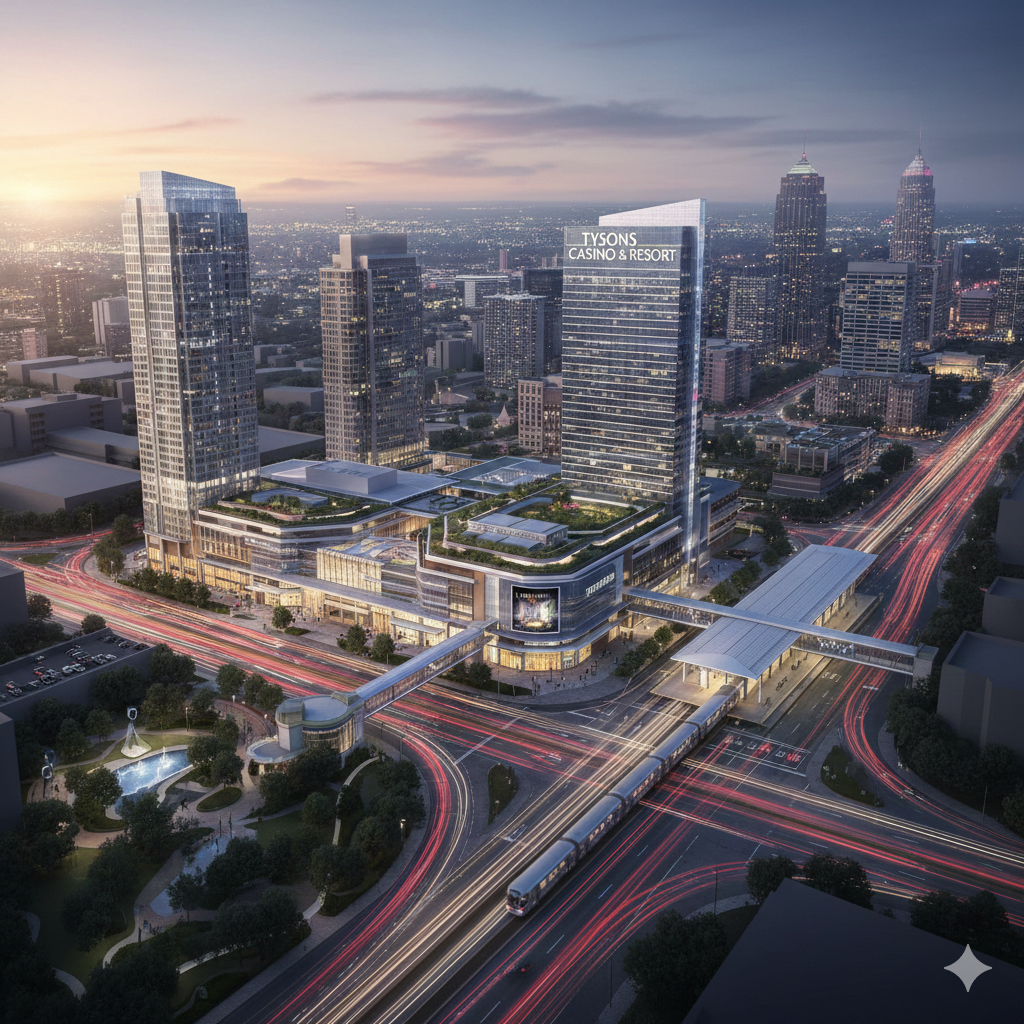
As of January 13, 2026, the prospect of a world-class gaming and entertainment district in Tysons, Virginia, remains one of the most contentious land-use debates in the Commonwealth. With the Virginia General Assembly officially convening its 2026 session tomorrow, lawmakers are once again considering legislation that would pave the way for a Tysons casino.
While proponents highlight a potential multi-billion dollar economic engine, local residents and the Fairfax County Board of Supervisors have signaled a “conditional opposition” that could stall the project for another year. Following a narrow 5–4 vote on December 9, 2025, the Board officially incorporated language into its 2026 legislative package opposing any state-led Tysons casino authorization unless specific local “guardrails”—including a better revenue split and a statewide gaming commission—are established first.
- State Level: Senate Majority Leader Scott Surovell (D) has confirmed that a new version of the casino authorization bill will be introduced during the January 2026 session.
- Local Level: On December 9, 2025, the Fairfax County Board of Supervisors voted 5–4 to formally oppose any casino legislation unless the state meets three strict “guardrails”: local land-use control, a statewide gaming commission, and a more favorable tax revenue split for the county.
The development of a Tysons casino is currently in the legislative proposal phase and is not yet approved. For the project to proceed in 2026, the Virginia General Assembly must first pass a bill designating Fairfax County as an eligible host. Subsequently, a local voter referendum must be approved by Fairfax County residents during a general election.
Also Read :SweepNext Casino Review 2026: Promo Codes, Games, and Prize Redemptions
| Feature | Detail |
| Primary Developer | Comstock Companies |
| Proposed Site | Within 1/4 mile of Spring Hill Metro Station (Silver Line) |
| Project Size | Approx. 4 million sq. ft. (Mixed-use entertainment district) |
| Gaming Space | Estimated 200,000 sq. ft. |
| Next Major Milestone | Virginia General Assembly 2026 Session Vote (Jan–March) |
As of January 13, 2026, the Tysons casino proposal is entering its most critical legislative window to date. While no casino has been approved for construction yet, the 2026 Virginia General Assembly session (commencing January 14) serves as the primary battleground for the project’s legal authorization.
Senate Majority Leader Scott Surovell and Senator David Marsden are expected to reintroduce legislation—building on the framework of the previous SB 982—to add Fairfax County to the list of Virginia localities eligible for a casino license.
(According to legislative tracking data…) Proponents argue that the decline in commercial office space tax revenue necessitates new “mega-project” revenue streams. However, the bill must clear both the House and Senate before moving to the Governor’s desk.
Also Read : Golden Clover Casino: A Complete Guide to Games, Bonuses, and Payouts
In a landmark 5–4 vote on December 9, 2025, the Fairfax County Board of Supervisors adopted a position of “conditional opposition.” This official stance, penned by Supervisor Walter Alcorn, signals to Richmond that the county will oppose any casino bill unless the following three “guardrails” are met:
- Local Request: The legislation must not be “imposed” by the state; it must originate from a formal request by the Board.
- Gaming Commission: A statewide, independent gaming commission must be established first to oversee regulations.
- Tax Split: The revenue distribution must be renegotiated to substantially benefit Fairfax County rather than primarily funding state-level projects.
The proposed “Tysons Casino” is not a standalone building but the centerpiece of a massive 4 million-square-foot mixed-use district.
The developer, Comstock Companies, has identified a specific site located within one-quarter mile of the Spring Hill Metro Station (Silver Line). This location is strategically chosen to minimize car traffic by leveraging the Metro, though residents remain skeptical of the actual impact on Route 7 and Route 123.
Based on the latest development filings, the project includes:
- Gaming Floor: 200,000 square feet (only 5% of the total project area).
- Hospitality: A luxury high-rise hotel and convention center.
- Entertainment: A state-of-the-art concert venue and performance hall.
- Housing: Integrated workforce housing units to meet county density requirements.
Also Read : Golden Lady Casino Review 2026: Games, Bonuses, and Safety Analysis
| Group | Stance | Primary Concern/Goal |
| Comstock Companies | Proponent | Revitalizing Tysons into a 24/7 “Entertainment Hub.” |
| No Fairfax Casino | Opponent | Impact on property values, traffic, and community safety. |
| Fairfax Board of Sup. | Conditional | Maintaining local land-use authority and fair tax splits. |
| State Lawmakers | Divided | Capturing “lost” gaming revenue from Maryland/DC. |
The debate over the Tysons casino is polarized between those viewing it as a necessary fiscal “lifeline” and those seeing it as a threat to the region’s urban planning and safety.
Proponents, led by State Senators Scott Surovell and David Marsden, argue that Northern Virginia is losing hundreds of millions in tax revenue to Maryland’s MGM National Harbor. They estimate a Tysons resort could generate up to $300 million annually for school construction and public services.
Opponents, including the No Fairfax Casino Coalition, cite studies suggesting that for every $1 in gambling tax revenue, social costs—such as increased welfare needs and crime—can range from $3 to $12.
Feature Potential Benefit (Pro) Potential Drawback (Con) Tax Revenue Could offset a $130M+ budget deficit and lower property taxes. Revenue often plateaus; may cannibalize spending from local businesses. Employment Creation of ~5,000 permanent union jobs and construction roles. Hospitality wages may not align with Fairfax County’s high cost of living. Transportation Promotes Metro usage via the Silver Line at Spring Hill Station. Adds an estimated 25,000 daily visitors to already congested Route 7. Entertainment Adds high-end hotels, concert venues, and nightlife. Concerns over increased crime, addiction, and human trafficking.
Even if the 2026 General Assembly session passes the authorization bill, the project faces a multi-step legal gauntlet before a single brick is laid.
Under Virginia law, a casino cannot be built without the explicit consent of the local electorate. If the state bill passes, the Fairfax County Board of Supervisors must then vote to place the issue on a general election ballot.
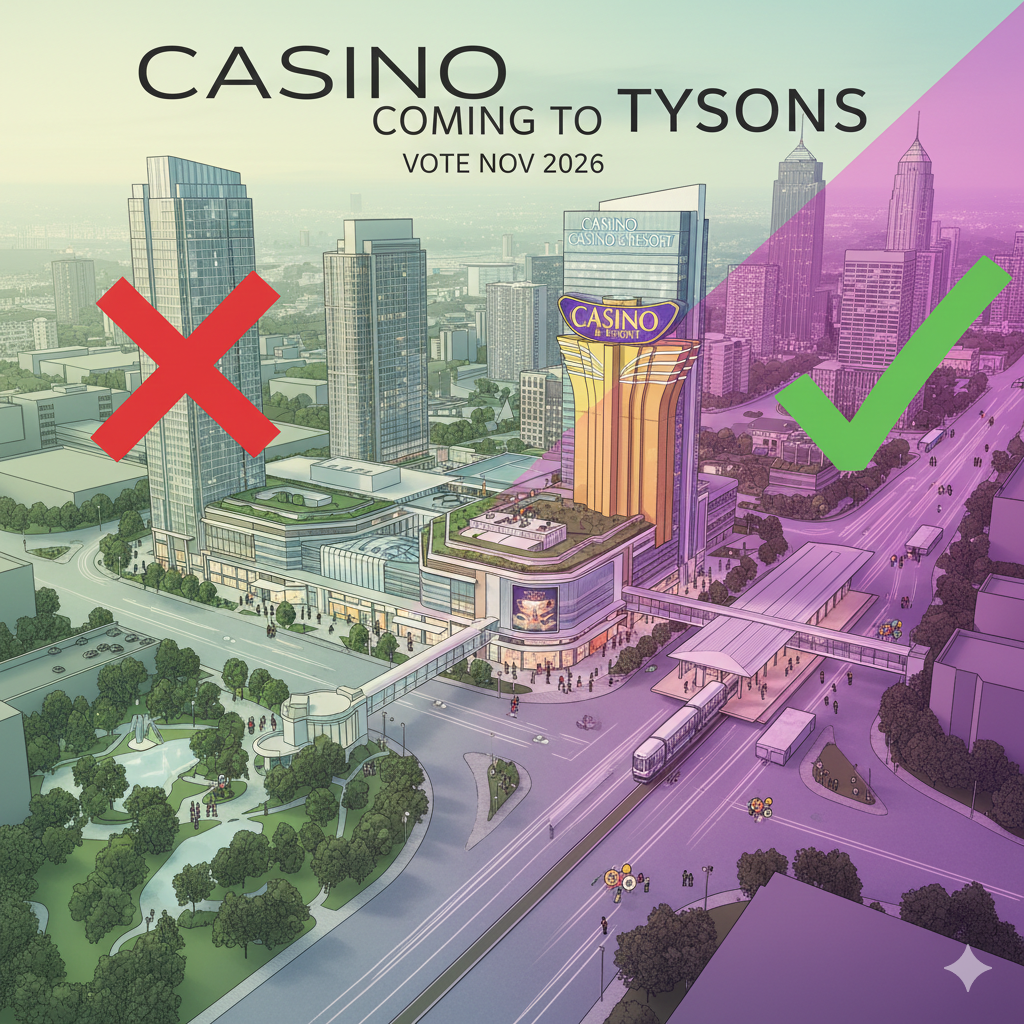
- The Referendum: Fairfax County voters would have the final “Yes/No” power in a referendum, likely scheduled for November 2026 or 2027.
- Public Sentiment: A late 2025 poll of likely Fairfax County voters showed 64% opposition countywide, rising to 79% among those living within the Tysons census-designated area.
A major hurdle in 2026 is the lack of a unified regulatory body. Currently, Virginia’s gaming is split between various departments.
(Based on industry standards…) Many supervisors refuse to move forward until a Statewide Gaming Commission is established to oversee money laundering protections, problem gambling support, and rigorous operator audits.
Unlike “distressed” cities like Danville or Bristol, Tysons is an affluent economic engine. This makes the “need” for a casino a central point of contention compared to other successful Virginia sites.
| Metric | Tysons (Proposed) | MGM National Harbor (MD) | Bristol/Danville (VA) |
| Primary Goal | Commercial Tax Base Diversification | Revenue Capture from VA/DC | Economic Revitalization |
| Transit Access | High (Silver Line Metro) | Moderate (Bus/Shuttle) | Low (Car-dependent) |
| Local Stance | Strong Opposition (5-4 Board) | High Community Support | High Community Support |
The Tysons casino debate remains a defining issue for Fairfax County in 2026. While proponents see a vital opportunity to diversify the tax base and recapture revenue from neighboring states, the local community remains largely unified in its opposition. With the Virginia General Assembly now in session, the immediate future of the project depends on whether state lawmakers will respect the “guardrails” set by the Fairfax Board of Supervisors or attempt to override local land-use authority. Regardless of the legislative outcome in Richmond, the ultimate decision likely rests with the voters in a high-stakes referendum.
1. Is a casino currently being built in Tysons? No. The project is currently in the legislative proposal phase. Even if authorized by the state in 2026, it must still pass a local voter referendum and undergo a standard county zoning and environmental review process.
2. Where exactly would the Tysons casino be located? The primary proposed site is the former Exclusive Automotive Group dealership lot at 8546 Leesburg Pike. This location is within one-quarter mile of the Spring Hill Metro Station on the Silver Line.
3. When will Fairfax County residents get to vote on the casino? A referendum can only occur after the state passes a bill and the Board of Supervisors requests the vote. If these steps happen in early 2026, the earliest likely date for a referendum would be November 2026 or 2027.
4. How much tax revenue would the casino actually generate for the county? Estimates vary wildly. Proponents claim up to $300 million annually for the state and county combined. However, current Virginia law only returns a small fraction of gaming taxes to the host locality. One of the Board’s key “guardrails” is a demand for a much larger local revenue split.
5. Who are the developers behind the project? The project is spearheaded by Comstock Companies in partnership with Clemente Development Co. They have previously proposed a 4-million-square-foot district that includes a hotel, concert venue, and residential units alongside the gaming floor.
6. Does the Fairfax County Board of Supervisors support the casino? The Board is deeply divided. In December 2025, they voted 5–4 to officially oppose any casino bill that does not meet their specific conditions, including local land-use control and the creation of a statewide gaming commission.
7. How would the casino affect Tysons traffic? This is a major point of contention. Proponents emphasize its proximity to the Silver Line to encourage transit use. Opponents argue that a 24/7 gaming resort would add approximately 25,000 daily vehicle trips to an already congested Route 7 corridor.
- Fairfax County Government: 2026 Legislative Program and Board of Supervisors Official Minutes (Dec 2025).
- Virginia General Assembly (LIS): Draft Legislation and Subcommittee Reports on SB 982 and HB 271 (2025-2026 Sessions).
- Virginia Lottery Board: Monthly Gaming Revenue Reports and Tax Distribution Statistics (2025).
- FFXnow / Connection Newspapers: Local Reporting on Tysons Land Use and Development Filings.
- Joint Subcommittee to Study the Feasibility of Establishing a Gaming Commission: Final Report and Recommendations (2024-2025).